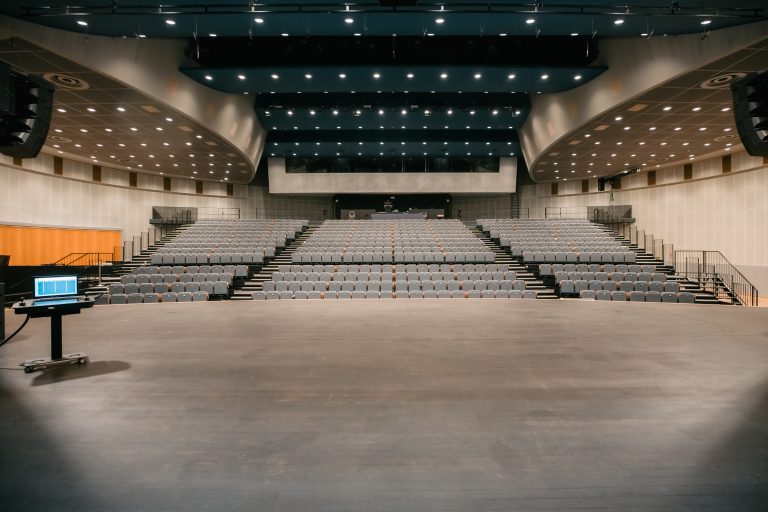
Where industrial engineering meets the show
From theatre rigging to casino grandstands to dark rides — we build the control layer that keeps the mechanics invisible.
A show only works when its mechanics disappear. What used to mean a technical crew pulling counterweights by hand before every performance, or a system rebuilt around whatever the next production needed, we put under one control layer instead — engineered so a small crew can run all of it with a single button, show after show.
The audience should never see the machine.
The Boolean way
Every project starts from the same two questions: what has to move, and what happens if it fails. We build the answer on industrial-grade controllers, with the moving parts, redundant control loops and safety logic sized to match — then bridge that industrial core to whatever runs the show or ride itself, so it can be triggered, monitored and adjusted without anyone touching the machinery underneath. The architecture is open by design, never locked to one supplier’s hardware or network, so it fits a single stage or a full entertainment complex — only the scale changes.

Theatre rigging
From counterweights to one button
Stage rigging used to mean a crew hanging counterweights by hand, rebuilding the whole setup before and after every show. We replace that with a control system where every batten moves — and stops — on command, at double the load capacity, with none of the manual labour, however many shows run in a week.
Structural motion
Hundreds of tonnes, moving on cue
Some installations aren’t lighting or scenery at all — they’re the structure itself. When an audience grandstand has to reposition on cue, that’s hundreds of tonnes of steel in motion, and there’s no margin for “probably fine.” We engineer that motion with the same safety rigour as an industrial production line: redundant control paths, hard limits, and a system that stops safely the moment something doesn’t match.


Ride & show integration
Ride control talking to show control
A dark ride’s animatronics, video and show elements don’t run on their own — they have to fire in sync with a vehicle that’s already moving. We build the communication layer between the ride’s own control system and its show control, so a trigger at the right point in the ride starts the right effect, and the ride gets confirmation back that it happened.
Safety, always
Built to move safely above an audience
Every one of these systems is open by design — no fixed hardware brand or network locks the architecture in — so the same approach fits a single stage or a full entertainment complex. And it keeps evolving: our current work is pushing toward the safety certification needed to move scenery and equipment directly above people, not just around them.